
ownersrep
advisory
tenzingone

When capital project owners hear BIM (Building Information Modeling), the conversation usually goes straight to software, models, and coordination meetings run by designers or contractors. What gets lost is the owner’s real need: governance, traceability, and decision confidence across the full lifecycle.
That’s where Tenzing One changes the conversation.
Tenzing One doesn’t try to replace design-authoring BIM tools. Instead, it makes BIM useful to owners by anchoring model information inside a structured, owner-side process—so BIM becomes actionable intelligence, not a disconnected technical artifact.
Most BIM platforms are optimized for creating and coordinating geometry. They excel at clash detection, visualization, and construction coordination. But for owners, BIM often fails at the moments that matter most:
Early planning and feasibility
Financial and schedule decision points
Governance approvals and public accountability
Risk, change, and claims documentation
Lifecycle handoff and long-term asset value
In practice, BIM data lives outside the owner’s operating system—in shared drives, design platforms, or consultant-controlled environments. The model exists, but ownership of the record does not.
Tenzing One delivers BIM differently—by treating it as data that supports owner decisions, not just geometry that supports design coordination.
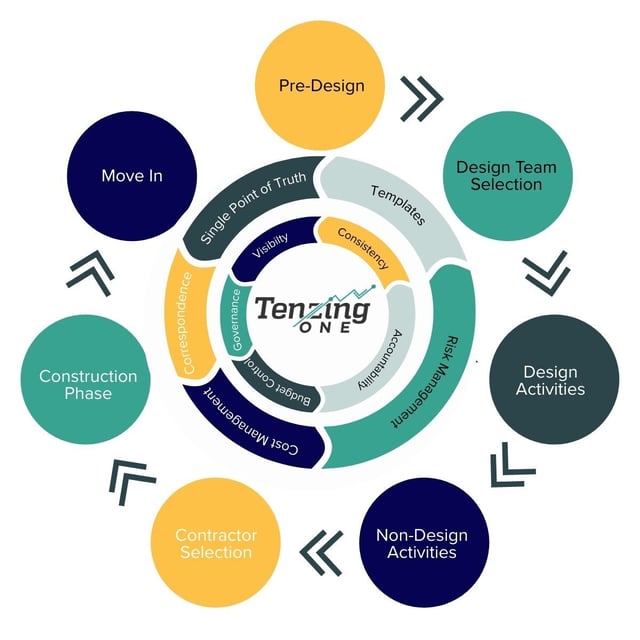
At the core of Tenzing One is its process map, built from decades of owner-side delivery experience. Every phase—from pre-design through closeout—is sequenced, governed, and documented.
BIM artifacts (models, views, quantities, coordination outputs) are attached to the exact task or decision they inform:
Concept models tied to feasibility and scope validation
Design models linked to cost, schedule, and risk checkpoints
Construction models associated with change review and approvals
As-built models connected to closeout and handover
This keeps BIM from floating outside the project narrative. The model supports the decision—and the decision is recorded.
Tenzing One aligns with Open BIM principles—not by forcing a single modeling tool, but by allowing owners to manage BIM outputs regardless of where they were created.
Owners don’t need to mandate one platform or police consultant workflows. Instead, they gain:
A single, defensible system of record
Clear linkage between BIM data, decisions, and approvals
Visibility across teams without owning the modeling burden
This is BIM without vendor lock-in—and without turning owners into model administrators.
What makes BIM valuable to owners isn’t the model itself—it’s what the model reveals.
Inside Tenzing One, BIM outputs are contextualized with:
Budget and commitment data
Schedule milestones and constraints
Risk items, assumptions, and value opportunities
Formal decisions and governance approvals
When a scope change occurs, the owner can see:
What model information informed the change
Who approved it, when, and why
How it affected cost, schedule, and risk
That connection is what makes the project record defensible.
Capital projects are long. Teams change. Consultants rotate. Project managers leave.
When BIM lives only in design platforms or personal drives, institutional memory disappears.
Tenzing One ensures:
BIM-related decisions remain attached to the process
Models and supporting files are retrievable by context, not guesswork
The owner—not a vendor—controls the authoritative record
This matters in audits, public meetings, disputes, and post-occupancy planning—when “who decided what, and why” matters more than any single model view.
Tenzing One doesn’t market BIM as a flashy feature. It treats BIM as critical project intelligence within the owner’s governance framework.
The result:
Better decisions, earlier
Less dependency on individual consultants
Stronger accountability and audit readiness
A complete project story—from intent to outcome
For capital project owners, that’s what BIM was supposed to deliver all along.
If your BIM data lives outside your decision process, you don’t really own it.
Tenzing One brings BIM home—into the system where owners lead, govern, and protect their capital investments.
If you'd like to speak to us about Tenzing One, please reach out today
.png?width=2240&height=1260&name=Owner%E2%80%99s%20Representation%20Is%20Evolving%20into%20Capital%20Advisory%2c%20and%20That%20Shift%20Matters%20(1).png)